BEFORE STARTING THE
ENGINE.
The
engine must be started on a free area, a suitable place is a recently mown lawn, free of
dust or anything else that could be drawn in by the propeller. In order to avoid polluting
the sail with oil from the exhaustion pipe and to lead the airflow towards a free area, it
is better starting the engine once without fastening the sail. Check, either by sight or
by touch, all the parts that could move, unfasten, and unscrew because of engine
vibrations. Since of many unpredictable situations that may occur, it is almost impossible
to set up a standard checking list for each one of you. What we strongly recommend is to
add your own procedure to the standard check
list. In this proceeding, caution and focusing is mandatory.
Do
check for anything that could hinder the right functioning of the engine!
Before
each starting:
Carefully
check for belts, wires, tubes, etc. to be tighten, if loosen they could be caught by the
propeller.
Open
the tank air hole, if any.
 Check
for the gas throttle to allow a full opening and full closing of the valve, one must hear a particular
sound from the carburetor, either shut or full open (a kind of tick). Should you not
perceive any sound, try to find out why; The wire may be damaged or frayed.
Check
for the gas throttle to allow a full opening and full closing of the valve, one must hear a particular
sound from the carburetor, either shut or full open (a kind of tick). Should you not
perceive any sound, try to find out why; The wire may be damaged or frayed.
Should
you not find out the solution to this problem, avoid starting the engine! The
throttle could be jammed full open!
You can keep hold the engine hold only at idle. Remember, once fallen
down to the ground there is no chance to get closer to it to switch it off. Check for the
earth wires not being frayed or cut, those in the thermostat (if any) of the motor head as
well.
A frayed contact
prevent the engine cut off
A skinned wire to
earth may cause undesired engine cut off.

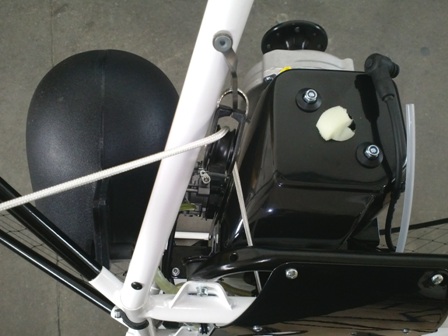
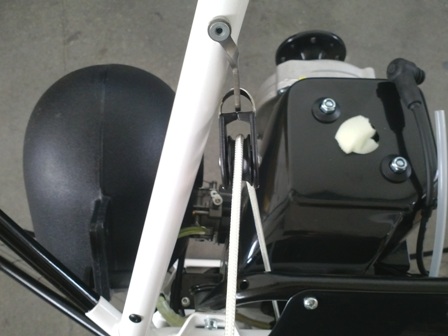
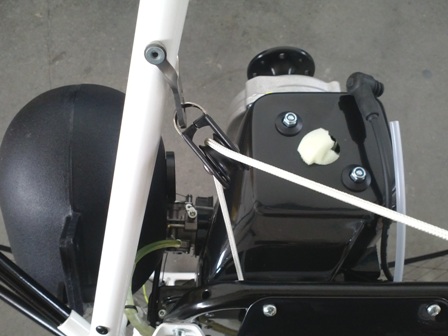
EMERGENCY SWITCH OFF
in case the swith of button doesn't work
the easyer way is to pull the remote
choke control
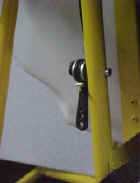
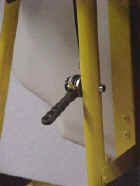
On MINIPLANE delivered after august 2008
there is a remote choke control: position pushed down is for starting
2
, pulled up is
position
1 for
normal operation .
On position 2 the engine can't run fast.
All the machine with valbro carburator
can be upgraded , visit our web shop
www.miniplane.net/shop
but please consider that in some case you
may not be able to find the handle
other emergency switch off can be made:
by a shunt between the coil low tension wire and the engine
ground
by shutting the gas tap or squeezing the gas pipe (may takes
about 10 seconds (valbro) or minutes (dell'orto) to stop)
by hand plugging the airflow to the filter.
|
Either
by sight and by touch, check all the reachable bolts and knots, those subjected to major
vibrations as well as those not easily reachable (muffler, springs, nuts, engine mounting), must be
checked at regular intervals (around every 10 hrs, or every two refueling).
By
hand turning the propeller check for the cage being, in every point, particularly near the
spokes, at a distance from the blades of 6-8 cm, 2.5-3 in. (4 fingers).
Check
the conditions of the propeller as well as the guard net.
Do not start the engine with people around!
Always follow the aeronautical procedures. Before starting the engine
do shout: “Prop clear”. Be sure to be heard by everybody around you. Avoid
people stopping or standing by your side.
The most dangerous places to stand are in the direction of the
plane of the propeller, since it is from this direction that any object, either forgotten
by the pilot or raised by the wind (belts, buckles, specs, screws, bolts, keys,
lighters...etc.) can be flung around at high speed.
At full rev, the prop's edge turns at 370 mph. pushing the air
backward at more than 62 mph. Do pay particular attention to the anti torque belt as well
as well as to the harness ones; do always fasten them before starting the engine. At these
speeds sand, grass, raindrops can badly damage the propeller, anything that bounces on it
can be shot around like a bullet. |

STARTING THE ENGINE
if you start the engine without the propeller
the
two stroke engine has little mass and without load it speeds up to full rev in a while,
you can easly over revs and damage the engine
the mechanical parts
have been designed for the speed rates thought with
the propeller
over
revving can be catastrophic for the integrity of the engine.
Do keep the engine hold to the ground when
starting the engine!
Before starting the engine make ready to resist the prop's thrust: do not hold the frame
by the guarding net!
Should you loose the catch you may enter straight on the prop's working area which is
invisible when the prop is turning.
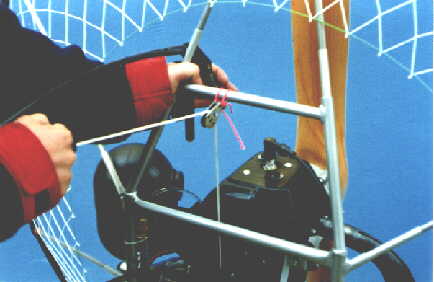 Hold the frame
only on the horizontal tube above the engine (the higher one) so not to press on the gas. Hold the frame
only on the horizontal tube above the engine (the higher one) so not to press on the gas.
Do prepare yourself to oppose to:
the starting handle drawing (hand-starting)
the prop's thrust
the prop's torque that, while revving up, could make the
framework turning, looking from the engine side it tends to turn clockwise (opposed to the
prop's rotation)
start the engine on the ground only with the choke on
position 2 (remote choke pulled down)
|
NEVER
LET A RUNNING ENGINE ALONE ON THE GROUND
PREPARE the starting on the ground only
with starter in start position ( the engine can't turn fast)
after the firts explosion of the engine
open the choke and start the engine again ONLY AFTER YOU PUT IT ON YOUR
SHOULDERS
it is the only way you have to control the
thrust generated by the propeller
|
TO START THE ENGINE
HAND-STARTER
can be done in 4 different positions:
standing up in front of the engine resting on the ground
standing sat after being harnessed
standing up after being harnessed
in-flight.
After holding the gas handle, so to get an easy access to the switch
off push-button:
gently pull the handle in order to find the initial
compression position
go back to the starting point by letting the string to rewind
(to get more stroke to go)
gently pull until hooking the starting device
than pull with firmness
-
pull
in the direction that
allows the pulley to self-orientate,
pulling in the side the
pulley suffers
overheating and wear
that can
quickly damage.
The engine resting on the ground must be held
by a hand on the frame about the same height of the recovery pulley
When you start it from this position while holding the
accelerator, you may involuntarily speed it up following the engine
thrust |
Do start the engine by a proper series of actions, particularly
do mind that the starting device or the pulling string may be damaged by:
by furious jerks in directions different from the natural one
from the recovery pulley
jerks without having allowed the hooking of the starting
device
a too long run of the string with overloading on the end of
the stroke
a too fast release of the starting handle (it must be gently
taken back to the resting point)
repeated attempts to start a flooded engine.
start with a float-type carburetor
with overflow collecting chamber
Do open the tap and pump by the hand pump until the fuel reaches
the tank. Check for the overflow pipe being connected to the fuel tank pipe.
At the very first starting it is necessary to flip up the
starter switch and hold it for 10/15 seconds after the engine is on.
if the Para
motor shifting is made with the engine leaned against the back of the harness, without
having previously emptied the carburetor's tank, it is possible the fuel pouring in the
engine sump |
do not try
to start the engine
gasoline cannot be compressed.
Only after the spark plug removal, try to run the engine (in
case of electric starter with intervals no longer than 10 seconds) to allow the fuel
discharging |
start with a diaphragm carburetor
The starting procedure must be differed form the very first
starting after a pause of many hours, and repeated ones. The carburetor is provided with a
diaphragm pump that starts up by the engine sump; it can suck up gas from the lower tank,
but in order to work properly, they must be wet of gas or fuel oil (evaporated mixture).
If the engine has been off for a long time, the depression
caused by the gas weight on the circuit may dry the diaphragms so that the carburetor
cannot perform its task. Do check the see-through gas pipe if the gas reaches the
carburetor, usually only few centimeters of the pipe are filled with gas and an air bubble
may arrive to the fuel tank. Those few centimeters are usually sufficient to start the
engine but they will be used up in a while and after few seconds the engine will tend to
cut out until it can suck up the mixture it needs.
If the engine has been off for a long time it may needs a
richer mixture for the very first starting (more gas and less air), in order to get it is
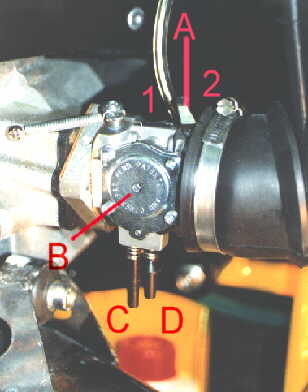
sufficient to flip up the starter switch A in
position 2 and start the engine until you
hear the first stroke, in case, let it run for few seconds. Do not insist too much since
the mixture sucked up very fast, may flood the engine. Than, flip the switcher back to
position 1
|
VALBRO |
TILLOTSON |
 |
 |
| A 1

A 1
|
A 2

A 2
|
If the engine has been off only for a score of minutes you do
not need any particular setting, simply restart it. Just pay attention to see if the
engine "abates" because of poor flow of mixture, in case, just give a bit of gas
so to flood the circuit before the engine shuts off.
Just after starting the engine may need being accelerated a
little bit.
The engine must start immediately, should it not happen after 2
or 3 attempts, avoid insisting and verify to have followed the right procedure.
The warm up takes at least a minute is necessary, the engine
must be steadily accelerated to reach the right working temperature and to free it from
waste
The warm engine with the right carburetion starts at the first
attempt.
With a bit of practice you will always find the suitable
technique, just bear in mind how long the engine has been off.
AFTER A LONG RESTING
or after a refueling, the gas pipe from the gas tank may
be partially or fully emptied.
To pump gas quickly :
Do shut the starter in position 2
and give full gas while pulling the starting handle. To ease the turning
of the engine and facilitate the fuel pumping, just remove the spark plug until the
circuit is flooded.
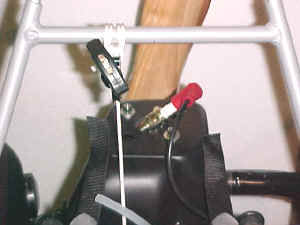
When the engine turn the spark plug, inserted on his cap, must
touck the head !
|
or fill the circuit by a light fuel overpressure
(acting on the hand pump or blowing by the mouth into the tank air hole) and operating the
diaphragm B by the tip of a ball-point pen
on the carburetor hole.
|
TROUBLESHOOTING
If the engine is flooded, is very
hard to restart it, do not insist.
There can be two type of solutions :
a) with a chugging engine unable to revving (strong chugs but
rare and uneven) do give full gas for few seconds, the flow of fresh air should improve
the carburetion, if not, shut it off and wait a minute before restarting it. The fuel
evaporation leads to a lean carburetion.
b) the flooded engine that does not chug is easy to recognize
because of the unburnt gas smell that comes out the muffler, the wet spark plug is unable
to cause the stroke. Remove the spark plug, give full gas and make the engine turning for
10 seconds. Fix the spark plug, after being dried by a flow of air or by a rug, the engine
should start immediately. If it does not start you may have to use a new spark plug
You can recognize a mixture too lean in presence of
frequent chugs but gradually less strong, that is the engine "abates", this is
normal during the first 30 seconds after the very first start. Should this continue for a
longer period you have better cheek the carburetion screws. The warm up demands
20-30 seconds, than you can give gas freely in order to clean out the waste.
For other kind of problems go to : troubleshooting.
MIXTURE
We recommend the use of a SYNTHETIC OIL , 1,5 to 2% in volume, (some oil can be use at lower rate).
we select some good quality oils,
www.miniplane.net/shop
We do recommend cleanliness while preparing the mixture.
We had the best results with premium petrol 97/98
octane, we think the reason is because the best quality of the gasoline not
because the higher octan number.
Lower octane number can be used on TOP 80 engine made after january
2000, (new head design).
You can use a gasoline with lower octane, you may have
just a light rising in the working temperature, in this case may be better to
reduce the compression, please ask to your local dealer.
You can use unleaded gas as well, but with a muffler without a
catalytic converter the exhaust gases are more polluting. Should this be the case, please
verify that the oil you use is suitable for this kind of gasoline.
The oil mixture made with synthetic oil must be used as soon as
possible, do not prepare to much of it.
It is better to store the fuel in metal tanks, you can
even use polyethylene tanks but only for short time.